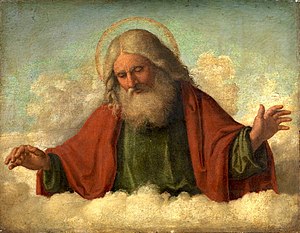
God and Lawn Care - GOD: Francis, you know all about gardens and nature. What in the world is going on down there on the planet? What happened to the dandelions, violets, milkweeds and stuff I started eons ago? I had a perfect no-maintenance garden plan. Those plants grow in any type of soil, withstand drought and multiply with abandon. The nectar from the long-lasting blossoms attracts butterflies, honey bees and flocks of songbirds. I expected to see a vast garden of colors by now. But, all I see are these green rectangles. St. FRANCIS: It's the tribes that settled there, Lord. The Suburbanites. They started calling your flowers 'weeds' and went to great lengths to kill them and replace them with grass. GOD: Grass? But, it's so boring. It's not colorful. It doesn't attract butterflies, birds and bees; only grubs and sod worms. It's sensitive to temperatures. Do these Suburbanites really want all that grass growing there? ST. FRANCIS: Apparently so, Lord. They go to great pains to grow it and keep it green. They begin each spring by fertilizing grass and poisoning any other plant that crops up in the lawn. GOD: The spring rains and warm weather probably make grass grow really fast. That must make the Suburbanites happy. ST FRANCIS: Apparently not, Lord. As soon as it grows a little, they cut it-sometimes twice a week. GOD: They cut it? Do they then bale it like hay? ST. FRANCIS: Not exactly, Lord. Most of them rake it up and put it in bags. GOD: They bag it? Why? Is it a cash crop? Do they sell it? ST. FRANCIS:
No, Sir, just the opposite. They pay to throw it away.
GOD: Now, let me get this straight. They fertilize grass so it will grow. And, when it does grow, they cut it off and pay to throw it away? ST. FRANCIS: Yes, Sir. GOD: These Suburbanites must be relieved in the summer when we cut back on the rain and turn up the heat. That surely slows the growth and saves them a lot of work. ST. FRANCIS: You aren't going to believe this, Lord. When the grass stops growing so fast, they drag out hoses and pay more money to water it, so they can continue to mow it and pay to get rid of it. GOD: What nonsense. At least they kept some of the trees. That was a sheer stroke of genius, if I do say so myself. The trees grow leaves in the spring to provide beauty and shade in the summer. In the autumn, they fall to the ground and form a natural blanket to keep moisture in the soil and protect the trees and bushes. It's a natural cycle of life. ST. FRANCIS: You better sit down, Lord. The Suburbanites have drawn a new circle. As soon as the leaves fall, they rake them into great piles and pay to have them hauled away. GOD:
No!? What do they do to protect the shrub and tree roots in
the winter to keep the soil moist and loose?
ST. FRANCIS:
After throwing away the leaves, they go out and buy something
which they call mulch. They haul it home and spread it around in place of the
leaves.
GOD:
And where do they get this mulch?
ST. FRANCIS:
They cut down trees and grind them up to make the mulch.
GOD: Enough! I don't want to think about this anymore. St. Catherine, you're in charge of the arts. What movie have you scheduled for us tonight? ST. CATHERINE: 'Dumb and Dumber', Lord. It's a story about... GOD: Never mind, I think I just heard the whole story from St. Francis.
---------------------------------------------------------------------------
Author Unknown
|
Sunday, 21 July 2013
God and lawn care
Sunday, 7 July 2013
Is it possible to live without regrets?
Every normal human being makes mistakes. We also quite
regularly make bad choices, that is, choices which we later regret. We make these unfortunate decisions
sometimes accidently, sometimes on purpose. Religious folks will refer to these
deliberate bad choices as sins.
There are mentally ill people whom psychiatrists label
"psychopaths". They are incapable of feeling remorse for any action. They lack the capacity to feel empathy for others. The material in this article does not refer to these unfortunate souls. Neither can they be regarded as being guilty of sin, since they cannot recognize any personal personality flaws or acknowledge any personal wrongdoing.
However, for most of us, we know very well when we have
deliberately made a choice which we
would not want to see printed on the front page of our local newspaper. If any
particular thought, word or deed were to become public knowledge, we would be
thorougly ashamed.
The small inner voice warning a person that he or she is
about to break a rule forbidden by training, law, culture or personal ethic is
known as "conscience".
Christians believe it is the voice of the Holy Spirit, encouring them to
stay on the straight and narrow path that leads to eternal life. However,
everyone has been given free will and no one is perfect one hundred per cent of
the time.
Conscience is a delicate gift. It can become numbed when
frequently ignored. If someone routinely cheats on tax returns, or conceals
items to avoid paying duty after shopping across a national border, the actions
will soon become rationalized with excuses like "Everybody does it",
or " I pay too many taxes anyway!".
For major wrongs such as theft, murder, perjury, or
intentionally causing serious harm, normal human beings will later experience
pangs of conscience and a nagging sense of regret. Is there any way to escape
this uncomfortable, distressing state of mind?
For many, their best hope lies in confessing to the
victim, or appropriate authorities, expressing sincere sorrow, and trying to
make amends for the wrong committed. Often, there will be punishment imposed: a
prison term, a compulsory fine, or mandatory community service. At the very
least, a relationship may be broken and a sense of trust destroyed.
Roman Catholic Christians have the Sacrament of Reconciliation to deal with regrets after
the commission of sin.
On Easter Sunday evening, Jesus appeared to the Apostles
and said: "Receive the Holy Spirit. Whose sins you forgive are forgiven
them. Whose sins you retain are retained." (John 20:20-23)
After receiving forgiveness from God, the next
step is to forgive oneself. This is not always easy, but the realization that
God has forgiven, challenges one to imitate the Divine and erase all memory of
past transgressions.
" It is possible to live
without regrets. Christians possess the best means to achieve this goal: (a)
ask God to forgive you, (b) believe that God has forgiven you and finally, (c)
forgive yourself.
"I have swept away your
offences like a cloud, your sins like the morning mist. Return to me, for I
have redeemed you." Isaiah 44:22
Going forward, firmly resolve to
avoid repeating that sin in the future.
Tuesday, 21 May 2013
How to make a difficult decision
We all have moments in life when we must make difficult decisions. Which job offer should I choose? Should I marry this person? Should we have another child? Shall I buy or sell my home? Shall I divorce or try to save this marriage? Is it time to move a parent to an assisted-living facility?
These can be times of indecision and acute stress. You honestly don't know what to do. How can you solve the dilemma? Are there steps to take to ensure that you will make the best decision possible? Many people have found the following procedure to be invaluable.
1. Pray
You may not know the best answer, but God does. He is all-wise. Being outside of time. He sees the past and the future at once. He is aware of the outcome of each of your possible choices. Acknowledge your confusion and ask for His help. The Bible says, "Ask and it will be given you." Luke 11:9. Take God at His word, He can be trusted.
It's fine to request a sign showing the right way; God is a loving parent, anxious to help.
2. Consult
Speak to knowledgeable people, the best experts you can find in the area that's troubling you. It may a doctor, a social worker, a psychologist, a clergy person, an accountant, a lawyer or several of these. Read up on the subject. Consult the Internet. Gather all the relevant information your can find.
3. Discuss
Speak with two or three trustworthy friends, preferably those who know all the people involved in your dilemma. State the problem clearly in an unbiased manner. Ask for their opinions. Listen carefully. Often God speaks through other people.
4. Paper and pencil
Divide a piece of paper into two sections, or more if necessary. At the top of one column write: "Option 1- Advantages". At the top of the second column: "Option 2-Advantages". If you have more choices, add more columns. List every advantage you can think of under each possible option. One column will probably have more items than the others.
5. Consider
By now, you probably know which course of action is best. Take a few minutes to plan the next steps you need to take, to implement your decision. It's a good idea to write them down while you have the time and are thinking clearly. Don't forget to thank God for His help.
Act decisively and without hesitation. Be assured that you have done everything possible to make the right decision. Trust God and trust yourself. Together, you make an unbeatable team.
Wednesday, 24 April 2013
How Great is our God!
God's
perfection and accuracy may be observed in many ways.
-the eggs
of the potato bug hatch in 7 days;
-those of the canary in 14 days; -those of the barnyard hen in 21 days; -the eggs of ducks and geese hatch in 28 days; -those of the mallard in 35 days; -the eggs of the parrot and the ostrich hatch in 42 days.
(Notice,
they are all divisible by seven, the number of days in a week!)
God's wisdom is seen in the making of an elephant. The four legs of this great beast all bend forward in the same direction. No other quadruped is so made. God planned that this animal would have a huge body, too large to live on two legs. For this reason, He gave it four fulcrums so that it can rise from the ground easily. The horse rises from the ground on its two front legs first. A cow rises from the ground with its two hind legs first. How wise the Lord is in all His works of creation! God's wisdom is revealed in His arrangement of sections and segments, as well as in the number of grains. -Each watermelon has an even number of stripes on the rind. -Each orange has an even number of segments. -Each ear of corn has an even number of rows. -Each stalk of wheat has an even number of grains. -Every bunch of bananas has on its lowest row an even number of bananas, and each row decreases by one, so that one row has an even number and the next row an odd number. -The waves of the sea roll in on shore twenty-six to the minute in all kinds of weather. All grains are found in even numbers on the stalks, and the Lord specified thirty fold, sixty fold, and a hundred fold all even numbers. God has caused the flowers to blossom at certain specified times during the day. Linnaeus, the great botanist, once said that if he had a conservatory containing the right kind of soil, moisture and temperature, he could tell the time of day or night by the flowers that were open and those that were closed! The lives of each of you may be ordered by the Lord in a beautiful way for His glory, if you will only entrust Him with your life. If you try to regulate your own life, it will only be a mess and a failure. Only the One Who made the brain and the heart can successfully guide them to a profitable end.
I HOPE YOU
FIND THIS AS FASCINATING AS I DID.
The
Bible
When you carry "the Bible", Satan has a headache, when you open it, he collapses, when he sees you reading it, he loses his strength, AND when you stand on the Word of God, Satan can't hurt you! And did you also know... When you are about to forward this email to others, the devil will probably try to discourage you, but do it anyway. "Life without God is like an unsharpened pencil - it has no point."
May God
Bless You In Ways You Never Even Dreamed Today!
|
Sunday, 21 April 2013
Thursday, 7 February 2013
Bible study for children: "Fear".
Have you ever gone for a boat ride on a summer day? The sun is shining; there is a soft, warm breeze and you can hear gentle waves lapping like music on the sides of your boat. It is a lovely experience.
But sometimes a boat ride can be scary. At night it is very dark. When a storm arises, the wind wails, the thunder booms and big waves rock the boat, until you think it is going to upset and you are going to drown in the cold, black water.
Jesus' Apostles had a very frightening boat ride one night on the Sea of Galilee.
That day, Jesus had been teaching and healing people. In the evening, he performed a miracle by feeding five thousand men plus more women and children with only five loaves of bread and two fish. In the evening he was tired. Jesus told his friends to take the boat and go ahead to the other side of the lake.
When the Apostles were far from shore, a fierce storm arose. Strong winds howled, lighting flashed, and the boat rocked wildly, like an out-of-control roller coaster. Just when the Apostles thought things couldn't get any worse, they saw a glowing, white figure walking toward them on the water. "Oh no!" they thought. "Now a ghost is chasing us!" But it wasn't a ghost; it was Jesus.
He didn't want them to be frightened. Right away he spoke: " Take heart, it is I; do not be afraid." Mt. 14:27
Peter, always the boldest, called out, "Lord, if it is you, command me to come to you on the water." Mt. 14:28. Jesus told him to come ahead.
Peter stepped out of the boat and took a few steps towards Jesus. He was doing very well when suddenly he stopped. He took his eyes off Jesus and looked around. He realized where he was and what he was doing. He became panicky and right away he began to sink into the dark, stormy sea. He called out to Jesus, "Lord, save me!" Mt. 14:30
Right away, Jesus caught Peter's hand, pulled him up, and they both got into the boat. Immediately the storm went away, and the lake became quiet and peaceful once more.
Then Jesus told Peter that he needed to have more faith. It he had trusted Jesus and kept his eyes steadily on the Lord, he would have been just fine.
Often we are like Peter. When stormy times come in our lives, we forget to trust Jesus. We get panicky about the bad things that seem to be happening to us, or around us, and we take our eyes off the Lord. Even then, when we call to Jesus for help, he is ready and anxious to save us.
We need to always remember that when we are Jesus' friends, when he is on our side, or as we might say, "in our boat", there is nothing to be afraid of. Jesus is God, Lord of heaven and earth, and he loves each one of us very much. He proved this by dying on the cross to save us.
Like Peter and the Apostles, we need to have faith and trust in him and not be afraid, no matter how scary things around us might appear to be. . We need only call on Jesus and he will always stretch out his hand to save us.
Monday, 4 February 2013
Why did Jesus come to earth?
"...I came that they may have life and have it abundantly." John 10:10
When our first parents were created, they had everything they could possibly want. They lived in a beautiful garden, where they would never have to work. There was no sickness or death. The animals were their friends and companions.
Best of all, God came daily and communicated with them. If they had proven their love and loyalty by obeying his one command, they would, in time, have been lifted to heaven to live forever with him.
Unfortunately, the humans ate the forbidden fruit, sentencing themselves and their descendants to the tragedies we must now all endure: sickness, death, pain, work and other hardships.
However, God still loved them and promised to send a Savior. God addressed Satan, the tempter, who had disguised himself as a snake:
" I will put enmity between you and the woman, and between your offspring and hers; he will strike your head, and you will strike his heel." Genesis 3:15
Indeed, Mary's son, Jesus, would seriously curtail Satan's ability to harm the world and its inhabitants, while Jesus would only be slightly affected by Satan's schemes to destroy him. Jesus' death would shortly be followed by his resurrection.
The sin of our first parents was very serious, because they knew God personally. They had daily witnessed his glory, his goodness, his majesty and his love. Yet, in spite of this, they chose to disobey him. This mammoth rejection of all that was perfect had to be atoned for.
Because an infinitely holy Deity had been offended, a mere human being could never atone for so great an offence.
Only Jesus could do so. He had two complete natures: human and divine. As son of Mary, he was human; as son of God he was divine. Thus, he was able to stand in place of humanity and offer the supreme sacrifice to Almighty God. Because Jesus was divine, his sufferings and death were sufficient to atone for every sin that would ever be committed on the earth.
Jesus came to earth to restore our relationship with God. Because of his sacrifice on the cross, we can now access heaven, even though we may commit sins. We only need to express our sorrow and do our best to repent. All our sins have already been atoned for by Jesus Christ.
There was another reason for the incarnation. On our own, a human could never really know God. He is, after all, Infinite Perfection. However, God loves us and desires to have a relationship with us, as he did with our first parents. When Jesus walked among us, he gave us a human face for God. Now we can more easily relate to the Divine, through the person of Jesus, the Second Person of the Blessed Trinity.
Because of Jesus' life and death, we do possess the possibility of obtaining abundant life, not only during our brief sojourn on earth, but most importantly, for eternity in heaven. Because Jesus came to earth, lived, suffered and died among us, we now have the opportunity to know God and to live forever with him in heaven. It's no wonder Jesus is referred to as "... the Savior of the world". (1John 4:14).
Saturday, 26 January 2013
Five reasons why monogamous relationships are healthy
From the time of the creation of first humans, men and women were meant to live in monogamous relationships. "Therefore a man leaves his father and his mother and clings to his wife, and they become one flesh." Gen. 2:24 Is it possible to tear flesh apart? Of course, but the result is extreme pain, trauma, and lifelong scars.
The sixth and ninth commandments confirm the Creator's intention regarding lifestyle. The Israelites were told not to commit adultery and not to covet a neighbor's wife. Jesus further sanctified marriage by performing His first miracle at the wedding feast at Cana.
Again, God confirmed that long-term, monogamous relationships are the ideal.
Why did an all-wise God establish this criterion? It was not for His good; He needs nothing from humans. It was for the benefit of the people He loved. Monogamous unions promote the spiritual, emotional, physical and financial health of individuals and the societies in which they live.
Following are five reasons why monogamous relationships are healthy:
1. Spiritual health. Happy, settled families are likely to live at peace with God and with the society in which they live. Because a married couple has energy and resources, they are more likely to reach out to others in need and in doing so, they may be led to thank God for the blessings and advantages they themselves enjoy.
2. Emotional health. Long-term couples have less stress; they are seldom lonely. Each one has a partner with whom to share joys and trials. In times of trouble they have the support of family members and friends to rely upon. They have established routines and traditions which help both day-to-day events and special occasions run smoothly.
3. Physical health. By having only one sexual partner, individuals avoid the STDs so prevalent in today's society: HIV-Aids, herpes, gonorrhea, syphilis, chlamydia, and other distressing and debilitating diseases. In addition, a caring partner will see that their spouse eats well, gets enough sleep and visits the doctor when necessary. It has been proven that married people live longer than their single counterparts.
4. Material well-being. Long-term monogamous relationships contribute to the prosperity of both partners. There are two to contribute to the family coffers and to pay off financial obligations. Large purchases are discussed and impulse buying avoided. Settled couples are more likely to eat at home, spend evenings at home and save on restaurant and entertainment bills. There are many opportunities to save as a couple: one residence, family insurance coverage, one donation to charities, one bill for utilities, and one gift to buy from both, on special occasions.
5. Finally, monogamous relationships are the healthiest types of building blocks for building and maintaining a healthy society. The family is the smallest social unit. It should be permanent. Children need a secure environment in which to grow. They need dependable, consistent male and female role models. Since time immemorial, the family has been the best context in which to raise a child, and children are the future. A progressive, healthy society can only be built on stable family units, in which the parents are devoted to each other and to their offspring.
God knew best when He mandated monogamous relationships for His people. Is a lifelong marriage easy to achieve? No. Will there be bumps in the road? Bumps? Sometimes even mountains! However, lifelong marriage remains the ideal toward which everyone should strive. God knows we are imperfect human beings. Sometimes we make bad choices, we fail, and we fall. There is not one of the Commandments that hasn't been broken by many of us. We must accept the graces God sends us, not give in to despair and keep striving toward the ideal. The most fortunate among us, with His help, will attain it.
Monday, 31 December 2012
Aaronic Blessing

Numbers 6:22-27
The Lord
bless you
and keep you;
the Lord make His face shine upon you
and be gracious to you;
the Lord turn His face toward you
and give you peace.
and keep you;
the Lord make His face shine upon you
and be gracious to you;
the Lord turn His face toward you
and give you peace.
New
Year's Eve, 2012 A.D.
Thursday, 27 December 2012
A theory of soul
My mother died of a brain tumour in 1976. For the last two
weeks of her life she was in a coma, in the hospital. She was completely
non-responsive. As I sat by her bed, I wondered. "Where is she?"
Obviously, her physical body was there, in front of me, in the hospital bed. It
was her soul that I wondered about.
As a Christian, I believed that humans are made up of body and soul. The body is physical, made of matter, created by God to live on earth for a limited time, and then to die. I was in the process of witnessing the final stage of Mom's bodily existence. It was heartbreaking, because she was the best parent anyone could ever have been privileged to have.
It would have been more bearable if I could have been assured that her soul or spirit, her essence, the part of her that knew and loved me, her grandchildren, our other family members and friends was no longer there, or perhaps was poised on the brink of eternity, ready and anxious to shed this gravely-ill body and proceed on the journey to her heavenly home.
I asked the devout hospital chaplain who had presided at the passing of numerous patients. "Father Michael, where is Mother's soul right now?"
He tried but he couldn't give me an answer that satisfied me. "Maybe God has some matters to take up with her before she goes. Or, perhaps she's using up some of her time in Purgatory."
That really didn't suffice. God was soon to have all eternity to sort things out with Mother. Besides, the Sacrament of the Sick, which she had received, removed all punishment due to sins committed during life. She shouldn't have to spend any time in Purgatory. Those were his best guesses, so I didn't press for more. But I continued to wonder.
For over 30 years, I've continued to wonder. The puzzle had become extended during this time, it now included those with brain injuries, Alzheimer's sufferers, even surgical patients under anaesthetic. Where is the person's soul during these times?
The body is physical, but the soul is spirit. Anaesthetics, trauma or disease should not be able affect the spirit, should it? Then, one night recently I finally heard an answer that made sense to me.
I've formed the habit of listening to the "Coast to Coast" radio program with George Noory on my Sony Walkman during the night. It helps when I can't sleep, and George's soothing voice doesn't disturb my slumbers, when I do nod off.
Some of the guests have very far-out ideas, some have vivid imaginations, and others are very interesting. One evening, a call-in listener who had been pondering the same puzzle as I had, came up with what seemed to me to be a reasonable explanation.
The brain is physical, it is part of the body. Its function is to collect information from the earth plane, using the five senses and to transfer the data to the mind. The brain is like a computer. It gathers information and transmits it to the mind. The computer can be damaged, or it can crash entirely.
The mind, or soul is spirit. During life, it receives and processes information the brain transmits. The mind thinks, makes decisions, feels emotions, knows people and places the body has been in contact with during life. The mind is superior to the brain. It is eternal.
When the brain becomes diseased, unconscious, or anaesthetized, the computer stops working. The mind is still present and functional, but the connection to the brain has been broken.
Where is the mind, during these times? Probably hovering near, as radio, TV and electrical waves are always around us, even when no receiving device is plugged in.
When the brain is out-of-order, the mind doesn't break through into the physical realm to make its presence known. It probably hovers near the ailing body, waiting to be fully released from its mortal bond. When the brain dies, the soul or mind proceeds to its eternal home.
I have no theological authorities to confirm this theory, I can only state that it satisfies me. After more than 30 years, I feel I know where Mother's mind was during those final days when she was in a coma. She was very near all the time, probably praying for her loved ones to be given peace and courage, even as we prayed for her to have an easy journey to her heavenly home.
Tuesday, 18 December 2012
Tuesday, 4 December 2012
Christmas in Heaven
I
see the countless Christmas Trees
around the world below,
with tiny lights, like heaven's stars,
reflecting on the snow.
The sight is so spectacular,
please wipe away that tear,
for I am spending Christmas
with Jesus Christ this year.
I hear the many Christmas songs
that people hold so dear,
but the sounds of music can't compare
with the Christmas choir up here.
I have no words to tell you,
the joy their voices bring,
for it is beyond description,
to hear the angels sing.
I know how much you miss me.
I see the pain inside your heart,
but I am not so far away.
We really aren't apart.
So be happy for me dear ones.
You know I hold you dear,
and be glad I'm spending Christmas,
with Jesus Christ this year.
I send you each a special gift,
from my heavenly home above.
I send you each a memory of,
my undying love.
After all "LOVE" is the gift,
more precious than pure gold.
It was always most important
in the stories Jesus told.
Please love and keep each other,
as my Father said to do,
for I can't count the blessings
or love He has for each of you.
So have a Merry Christmas
and wipe away that tear,
Remember, I'm spending Christmas,
with Jesus Christ this year. Author unknown
Monday, 12 November 2012
Saturday, 27 October 2012
Why Go to Church?
A Church goer wrote a letter to the editor of a newspaper and complained that it made no sense to go to church every Sunday. "I've gone for 30 years now," he wrote, "and in that time I have heard something like 3,000 sermons. But for the life of me, I can't remember a single one of them. So, I think I'm wasting my time and the pastors are wasting theirs by giving sermons at all."
This started a real controversy in the "Letters to the Editor" column, much to the delight of the editor. It went on for weeks until someone wrote this clincher:
"I've been married for 30 years now. In that time my wife has cooked some 32,000 meals. But, for the life of me, I cannot recall the entire menu for a single one of those meals But I do know this.. They all nourished me and gave me the strength I needed to do my work. If my wife had not given me these meals, I would be physically dead today. Likewise, if I had not gone to church for nourishment, I would be spiritually dead today!" When you are DOWN to nothing.... God is UP to something! Faith sees the invisible, believes the incredible and receives the impossible! Thank God for our physical AND our spiritual nourishment!
Anon.
Saturday, 18 August 2012
Reflection on a granddaughter's graduation from high school
As preparations were made for my granddaughter Heather's prom this Spring, I couldn't help recalling a similar occasion fifty years ago. In the all-girl Catholic school I attended, the grand event was called, "The Graduation Dance".
The panicky feeling began to build right after Christmas holidays. The girls were looking forward, with varying degrees of anticipation and anxiety, to the dance. Everyone was expected to attend. However, for many of us there was a formidable challenge to be overcome first: we had to find and invite a suitable escort.
A few of the girls already had boyfriends. Those with brothers could always ask one of his pals, or if all else failed, the sibling might be threatened or bribed to go himself. Some girls traded brothers or male cousins for the evening. Unfortunately, my friend Frances and I were socially challenged: we had only one younger sister apiece.
We had attended all-girl schools since first grade and teenage boys were scarce in our social circle. If one approached me on the street, I'd cross to the other side after a rapid internal debate. "Should I speak? What if I spoke and he didn't answer? What if he did? What could I say next?" I'd invariably decide it was easier to avoid the whole problem. However this was a situation I couldn't escape. I had to find an escort, or be considered a social outcast forever.
First, I invited the boy who delivered groceries. He said, "That's the day my grandfather died. I always visit the cemetery. Sorry." In the evening? In the dark? At least he deserved an A for originality.
Next, I called the older brother of my sister's friend. When he finally figured out who I was and what I wanted, there was a long moment of silence. Then he squawked abruptly: "I think my mother's calling me," and dropped the receiver. He returned shortly to say that he was very sorry, but he had a previous engagement. I could hear the relief in his voice; his mother had saved his neck.
My mother was doing her best to help. She methodically canvassed her friends with sons of an appropriate age, but she had no luck. Things were getting desperate! I began to wonder, "If a person decided to enter the convent, could she go right away, before June 5th.?"
Mother, never one to concede defeat, was considering importing a cousin from up north. He was younger, but tall for his age. If I could convince him to keep quiet about our kinship, he might even pass for a real boyfriend!
Suddenly, the phone rang. Frances' mother had had a nibble! There was one problem: the boy wanted to bring a pal. Would I go with his friend? Was she kidding? Good-bye convent, hello dance!
The preparations began in earnest. Long gowns, matching shoes, gloves, and evening bags were purchased. The good Sisters had warned us repeatedly not to wear strapless evening gowns, in fashion that season, but they failed to tell us why. Our curiosity was thoroughly aroused and some of the more daring among us might have tried, but we knew we'd never get away with it! Someone would squeal.
We practiced for hours, dancing in high heels to the music of the record player. It would be most unladylike to fall flat on one's face in the middle of the dance floor!
After 50 years, I can't remember much about the dance but I do remember the boy. His name was Gerry, and he was as wary of me as I was of him. I spent the evening trying to make him feel more at ease. If he panicked and made a break for the door in the middle of the evening, it would have been more embarrassing than not having gone at all!
Fortunately, circumstances have improved during the past half-century. Heather, who has always been in a coed situation in school, is perfectly comfortable with friends of both sexes. She went to her prom with a group of girlfriends. There was no anxiety, no pressure, just an evening of elegance and fun shared with peers.
To all the graduates of 2007, enjoy the prom, the last hurrah of your secondary school career. You should smile with satisfaction and confidence as you doze off after the big evening. You will soon realize that nothing lasts forever and tomorrow will be a big day too. It will be the first day of the rest of your life
How does someone become a saint?
For Catholics, canonization it is a formal declaration by
the pope that the person named is in heaven. There is a definite procedure the
Church follows before the Pope will declare a new saint.
A detailed investigation is conducted into the person's earthly life, to make sure he or she committed no serious, ongoing sin. In addition, there must be evidence presented of at least two scientifically-proven miracles which occurred after this person had died and their help was sought in prayer.
There are many saints in heaven whose names are unknown.
They are holy people who lived lives of quiet sanctity without attracting
attention. Many people have family members in this category.
Imagine, if you will, the saints' present situation. They
are eternally happy, praising God in heaven. However, just as their family
members and friends do not forget them, they do not forget those they left
behind on earth. They are in a splendid position to petition the Almighty for
favours to help their loved ones on earth. They are close to the throne of the
God of infinite love. They can ask more effectively and powerfully than folks
on earth who are easily distracted and plagued by doubts which assail their
already weak faith.
Catholics do not pray to saints. Rather, they ask the help
of saints in bringing requests to God. They honour the saints; they study the
lives of the saints and use them for role models. Devout parents often give
their child the name of a saint, thus asking the holy one to look out for the
child, guide him through life and help him attain heaven.
Catholics look upon the saints as friends, helpers, human
beings who have successfully completed their earthly journey. Catholics believe
in the doctrine of "The Communion of Saints", as mentioned in the
Apostles' Creed.
There are three levels of existence in which a human may
find himself or herself. Those on earth, are referred to as the church
militant. They are struggling against temptations from the world, the flesh and
the devil. They can pray for the souls in Purgatory. They can ask for help from
the saints in heaven.
Souls in heaven are referred to as the church triumphant.
They are the saints, both known and unknown who have reached their goal. They
can pray for those on earth, and also for the souls in Purgatory.
Those in Purgatory are called the church suffering. These
souls left earth with some sins or imperfections on their souls. They are
undergoing a purifying process which will make them fit to enter the perfection
of heaven. Their time of suffering can be lessened by the intercession of those
in heaven and those on earth.
The "Communion of Saints" is a circle of friends
on a cosmic scale. It's been said that Christians don't go to heaven alone.
They go with and through other people. The Church community transcends time and
space as we know it.
Catholics, then, do not pray to saints as they pray to God.
Catholics ask the saints to present their prayers to the Almighty from the more
advantageous position which the saints enjoy. The scores of requests granted
through the intercession of the saints are convincing testimony to the
effectiveness of this tradition.
Saturday, 4 August 2012
Memoirs: First Day in Grade One
The most memorable first day in Grade 1 for me, was that of my sister. I'll never forget it because it scared the daylights out of me. Although I wasn't directly involved, I expected the fallout from her undisciplined antics would result in lightning bolts, excommunication,or leprosy, or maybe all three, to be visited on our hapless family.
The year was 1946 and the setting was the cloakroom of our Catholic girls' school. The characters were the first-grade teacher, Sister Emmanuella, my mother, my sister, Mary Elizabeth, a group of little girls gathered around to see the new student, and me.
Sister Emanuella was a sturdy woman, dressed in the traditional habit of the Sisters of St. Joseph: long black dress, veil, and shoes with a white wimple around the neck. From the black cord around her waist hung a large wooden rosary. It reached almost to the floor and beads clunked against each other when she walked fast. She was a strict disciplinarian, and all the students (and parents) had a healthy respect for her.
Mother, (a recent convert from Presbyterianism) was a doting parent, and she might be forgiven for wiping away a tear or two as she handed over her youngest to this formidable personage. I had been in school two years already, so she would spending her future days in lonely solitude, or so she thought.
Mary Elizabeth (known as Lizard to family and friends) was a child of strong character. Since there was no Kindergarten in those days, this was her first experience with school. She took one look at Sister's deadpan countenance and decided she wanted none of it. She had enjoyed two years of Mother's undivided attention while I was in school. She did not want to give up that halcyon existence for an unknown environment with this menacing-looking creature.
Now Lizard was small and scrawny, but she was wiry. Mother had picked her up and tried to hand the kicking, screaming child over to Sister. Feeling Sister's firm hands around her, Lizard kicked even more vigorously. Sister held on tight, but she got very red in the face. The screams rose to a piercingly high pitch. The little girls put their hands over their ears and some of them started to cry.
Suddenly, there was a clunking sound of wood on wood. I looked in horror at the floor. Lizard had broken the rosary, and it hit the polished hardwood surface with a clatter. Sister's face was now scarlet and I'm not sure to this day whether it was from anger or exertion. There was suddenly silence. Even Lizard shut up.
I wasn't sure what would happen next. Lightning bolts were a distinct possibility, and excommunication for sure. Boy, was my dad ever going to be mad! We were always hearing about leprosy in Bible stories; maybe we'd all come down with that disease and have to live by ourselves outside the city like the early Jewish victims.
Sister unceremoniously plunked Lizard back on the floor. She asked me to pick up the beads. She told my mother that she really thought Mary Elizabeth wasn't ready for school yet. She suggested leaving her home for another a year. Lizard stopped howling. Mother agreed and escaped as quickly as possible, after having offered to pay to have the rosary repaired. Sister said that wasn't necessary. I suspected the angels would probably come in the night and fix it. Sure enough, next day it was as good as new!
The next September, when Lizard actually did start school, Sister Emanuella had been moved to another assignment in a different city. I guess the Lord had a special place in his heart for her.
Now, there are few Sisters left, and most of them dress in ordinary street clothes with only a cross around their neck to indicate their special status. I'm glad I had the advantage having had them as teachers, they were strict but fair. They honestly had the well-being of the children at heart, even those as difficult as Mary Elizabeth.
Oh, and nobody in our family ever did get leprosy, at least not yet.
Friday, 3 August 2012
Common reasons why people leave church
People
stop attending church for a variety of reasons. Among the most common are:
* I'm too busy.
Really? During the week, the Almighty gives you 168 hours of life, food to eat, a roof over your head and numerous moments of peace and pleasure with friends and family. Can you begrudge Him an hour or two on Sunday in return? Does that not seem like the ultimate in ingratitude?
* I don't believe in God.
This
can be a convenient excuse If everyone
took time to observe and reflect on the beauty of the world around them: the
glory of a sunrise, the cycle of seasons, the perfection of a newborn, the
unerring rhythm with which the universe and everything in it operates, he or
she would realize that all creation bespeaks the hand of an all-wise and
all-loving Creator.
* There
are too many sinners and hypocrites at church.
Agreed. Churches are full of sinners and hypocrites. What better place could they be? Aren't we all sinners? Most of us are also hypocrites in some manner or other. Jesus said: "I have come to call not the righteous but sinners to repentance." Luke 5:32
* I don't need church. I can pray at home.
Everyone
should pray at home, but we were meant to worship in community. Consider the
prayer Jesus taught. He instructed us to address God as a group: "Our
Father...", and again, "Give us this day our daily bread...",
and "forgive us our trespasses". Individual prayer is good, but group
prayer is more powerful. " For where two or three are gathered in my name, I am there among them. " Matthew 18:20
* God
doesn't care about us. Look at all the evil in the world.
There is much evil in the world but when the causes are examined closely, they are mainly rooted in man's inhumanity to man. God gifted humans with free will. When that will is used for evil, it is certainly not God's fault.
Also,
the earth and everything in it was created perfectly. With the fall of our
first parents, sickness and death became part of our destiny.
The planet, too, shared in humanity's loss of perfection. Some of the animals became ferocious, crops no longer grew without a farmer's effort, and floods, earthquakes and other natural disasters came into being.
God
however, did not leave his beloved children without a means of help and a guide
to salvation. Jesus established the Christian Church to guide us through the
chaos of earthly life and enable us to find our way back to God and our eternal
home. Those who make excuses, leave the church, and try to find the way on
their own, do so at their peril.
Saturday, 21 July 2012
How to find contentment
1. Develop your religious faith. Attend services. Do some spiritual reading. Recall all the "close calls" you've had in life thus far, when you avoided misfortune by the skin of your teeth. Meditate on the fact that you are the precious child of a loving Father, who is the King of the universe and in charge of all the circumstances of your life. Turn everything you can't handle over over to Him, and trust Him to take care of it.
2. When you find yourself becoming worried or upset, count your blessings. They always outweigh the problems of the moment. If you have clean water to drink, a roof over your head and you know where your next meal is coming from, you're already more fortunate than many people in the world.
3. Remember the people in your life whom you love, or who love you. Each one is a treasure to be cherished. Plan to do something to enrich the life of each one within the next few days. Bake cookies to share, write a cheery letter, make a thoughtful phone call, invite someone to lunch. Show each one you appreciate their presence in your life.
4. Take up a hobby, one that is creative and gives you a sense of accomplishment: knitting, crocheting, sketching, wood-working, writing, even paint-by-number sets will produce items in which you can take pride, display in your home, or use as gifts.
5. Volunteer in the community. Each of us of has special gifts which were meant to be shared with others. Working in a soup kitchen, with an "Out of the Cold" program, visiting the sick or shut-ins, reading or writing letters for the blind, all of these and similar activities will reward the volunteer with well-deserved feelings of satisfaction and contentment.
6. Work on making your immediate environment a haven of comfort, attractiveness and tranquility. Even if you only have one room, it should boast comfortable furniture, a pleasant blending of your favourite colours, pictures of your loved ones, and a collection of books, puzzles and your current project or hobby. Your private area, though small, will ward off depression and that old " there's no one to care and nothing to do" mood.
7. Be aware of local and world events, via television, radio and/or newspapers. Even if your life is uneventful at present, matters of great import are probably occurring elsewhere. If you are lucky enough to have access to a computer you can "put in your two cents worth" at network news sites, where your views will be read by thousands of people, and maybe more.
All of us have periods of discontent. Family members can be thoughtless, friends come and go, and the pup you thought was house-trained has regressed, but you can possess contentment nevertheless. Use some or all of the above suggestions and work towards being perfectly comfortable in your own skin and within your own little universe. Then you'll be ready to reach out and share your peace and tranquility with others when they are sorely in need of it.
Fortify yourself with contentment, for this is an impregnable fortress. Epictetus.
Tuesday, 3 July 2012
St. John Bosco
Believe me...nobody can be truly happy in this world unless he is at peace with God." John Bosco
John Bosco never had the opportunity to experience happiness through the possession of material wealth. When he was born in a small cabin at Becchi, Italy, on August 16, 1815, his family was very poor. His father, Francesco Bosco, worked a tiny farm in the village, providing the family with barely enough to survive.
When John was only two years old, his father died, leaving his mother, Margherita, to raise John and his two older brothers, Anthony and Joseph. Everyone had to work hard to keep food on the table. John helped by tending the cattle and gathering sticks for the fire.
In the evenings, Margherita taught her boys about God. Often, John would follow her around as she performed works of charity for neighbors who were even poorer than her own family. When his mother tended the sick, John would gather the children outside and teach them to pray.
At the age of nine, John had a vision in the form of a vivid dream. Jesus and Mary appeared to him and revealed that his mission in life would be to teach other boys about the evils of sin and the beauty of living a virtuous life. This dream had a vital impact on his future plans.
John studied the street entertainers who were a common sight at that time: jugglers, magicians and acrobats. With persistent practice, he soon learned enough skills to attract other children. After the entertainment, he would teach them prayers and lessons from the catechism.
As he grew older, John continued to support himself by performing farm chores while he continued his studies. He entered the seminary at age 20 and, in 1841, the archbishop of Turin ordained John Bosco a priest.
He began his ministry in the town of Turin, Italy, where many young men had migrated, hoping to find jobs as the Industrial Revolution commenced. John Bosco searched out those living alone, those sleeping in the streets or languishing in jail. For these needy youths, he opened a youth center, or "Oratorio." Working from the Oratory, John looked for jobs for the unemployed, tried to obtain fairer treatment for those who were working, and taught academics to those willing to study after completing a day's work.
The Oratory expanded to accommodate apprenticeship classes for book-binders, carpenters, printers, mechanics, tailors and shoemakers. John established the order of Salesian Brothers to help with these enterprises.
As the Oratory grew, an ever-present problem was lack of funds. John's mother, Margherita, moved to Turin and sold her wedding ring and the few other jewellery pieces she still possessed to help buy food and necessities. By the early 1860s, the number of boys and young men sheltered by the Oratory was 800.
Some of these youths decided to spend their lives serving other needy young men. Thus began the Salesian Order of priests. John Bosco also founded an order of religious nuns: Daughters of Mary, Help of Christians.
Before his death, John Bosco founded 59 Salesian houses in six nations. Today the Salesians serve others in many countries around the globe.
The saint himself published a series of popular books and invented a education system founded on the values of reason, religion and love. Many educators today recognize it as an ideal system for training young people.
Don Bosco died on January 31, 1888. His last words to the Salesians watching at his bedside:
"Love each other as brothers. Do good to all and evil to none.... Tell my boys that I wait for them all in Paradise."
John Bosco was canonized a saint of the Roman Catholic Church by Pope Pius XI in 1934. He is the patron saint of apprentices, boys, laborers, school children, students and young people.
Subscribe to:
Posts (Atom)